What's new in Taqdim: November 2026
What shipped in Taqdim from mid-October to 11 November 2026: the fit check, tailored CVs and cover letters, CV re-import and the Chrome extension.
Short answer: in the last month, Taqdim's fit check learned to read language requirements from your profile, tailored CVs stopped printing your salary and got readable dates, cover letters now go through the same claim checks as the CV, importing an updated CV no longer duplicates your profile, and the Chrome extension is on the Chrome Web Store with steadier form filling. The How to apply guide now has a video in English and in Arabic.
This covers changes that were live on taqdim.app and app.taqdim.app on 11 November 2026, roughly mid-October to that date. Taqdim is in invite-only beta, so you need an invitation to try them.
The fit check
You paste a job posting, and Taqdim checks how well your profile fits before it writes anything. Two changes this month:
- Language requirements come from your profile. If a posting asks for "Fluent Arabic and English" and your profile lists Arabic as native and English as fluent, that requirement is now met without asking you again. Only the native and fluent levels settle it. A lower level, a language missing from your profile, or a vague requirement still comes to you as a question. Your profile never marks a requirement as failed, and an answer you gave yourself always wins over it.
- The tracker follows a changed verdict. If you change an answer and the verdict changes with it, the job moves to the matching place in your tracker. If you had already moved it yourself (to Applied, say), it stays where you put it.
There is a closer look at how the fit check handles knockouts in How Taqdim's fit check flags knockout requirements.
Tailored CVs
- No salary on the CV. Your current and expected salary stay in your profile and are used only to fill application forms. They never print on a CV.
- Personal details at the end. On a Gulf-style CV, the personal details block (visa status, notice period, date of birth and the like) is now the last section, written as one compact line of items.
- Readable dates. Role headings print the month and year, such as "Jan 2022", in English or in Arabic, instead of "2022-01".
- No doubled place names. When an employer's name already ends with its city, the city isn't printed a second time.
- No repeated role headings, and the Skills section no longer comes out empty when your tools are saved as one comma-separated list.
- Stricter checks on names. A bullet that names an employer, client or place your profile doesn't mention for that role is refused. That includes the company you're applying to, unless you really worked there.
- The right CV style from the extension. If you start from the extension without choosing a style, a job in a Gulf country now gets the Gulf-style CV, as it already did in the app.
These checks are designed to keep the CV to what your profile says. AI can still make mistakes, so read every CV before you send it. More detail is in Tailored CVs and cover letters in Taqdim.
Cover letters
- The CV's claim checks now run on the letter. Each paragraph is checked for employers, clients and places your profile doesn't name, for claims such as "banks" or "government clients" your profile doesn't back, for a single client turned into a plural, and for a seniority word your role titles don't carry.
- The employer you're applying to can't be turned into a past client. A sentence such as "I delivered chatbots for [the company you're applying to]" is refused unless your profile says you did. Sentences about why you want to join them still pass.
- The full letter in form fields. When the extension types your letter into a "Cover letter" box, it now includes the greeting and the sign-off, as the PDF does.
Importing your CV
- Import an updated CV without duplicates. When you import a newer CV, roles, degrees, certifications, languages and skills already in your profile are shown as "Already in your profile" and left out. A role you already have gets only its new bullets. Nothing you edited by hand is changed.
- A clear message for an unreadable file. If no experience or education can be read from a file (a scan with no text, for example), the import stops and tells you how to export a text PDF, instead of leaving you with an almost empty profile.
- Lighter photos. A photo for a Gulf-style CV is cropped to a portrait shape and resized in your browser before upload.
The Chrome extension
The Taqdim extension is on the Chrome Web Store. The version there on 11 November 2026 is 1.0.2. Changes since mid-October:
- Multi-step forms. On forms that change steps inside the same page, such as Workday, the panel tells you when a new step appears so you can capture it.
- Honest fill reports. If a site refuses a value or cuts it short (a number field that won't take "25,000 AED", say), the field is reported as not filled and marked for you to answer, instead of being counted as filled.
- Clearer field states. Filled fields, fields waiting for your answer and fields left empty now differ by outline style and a small text label, not by colour alone, and the panel lists why each failed field failed.
- The right job for the right form. When you choose a job under "Apply as", that choice is tied to the page and the tab. Open another job's form and the choice is dropped, so one job's CV doesn't land in another job's form. It is kept across the steps of the same application and when Apply opens a new tab for the same job.
- Corrected contact details. If you fix your phone number or email in your profile after preparing an application, the next fill uses the corrected details.
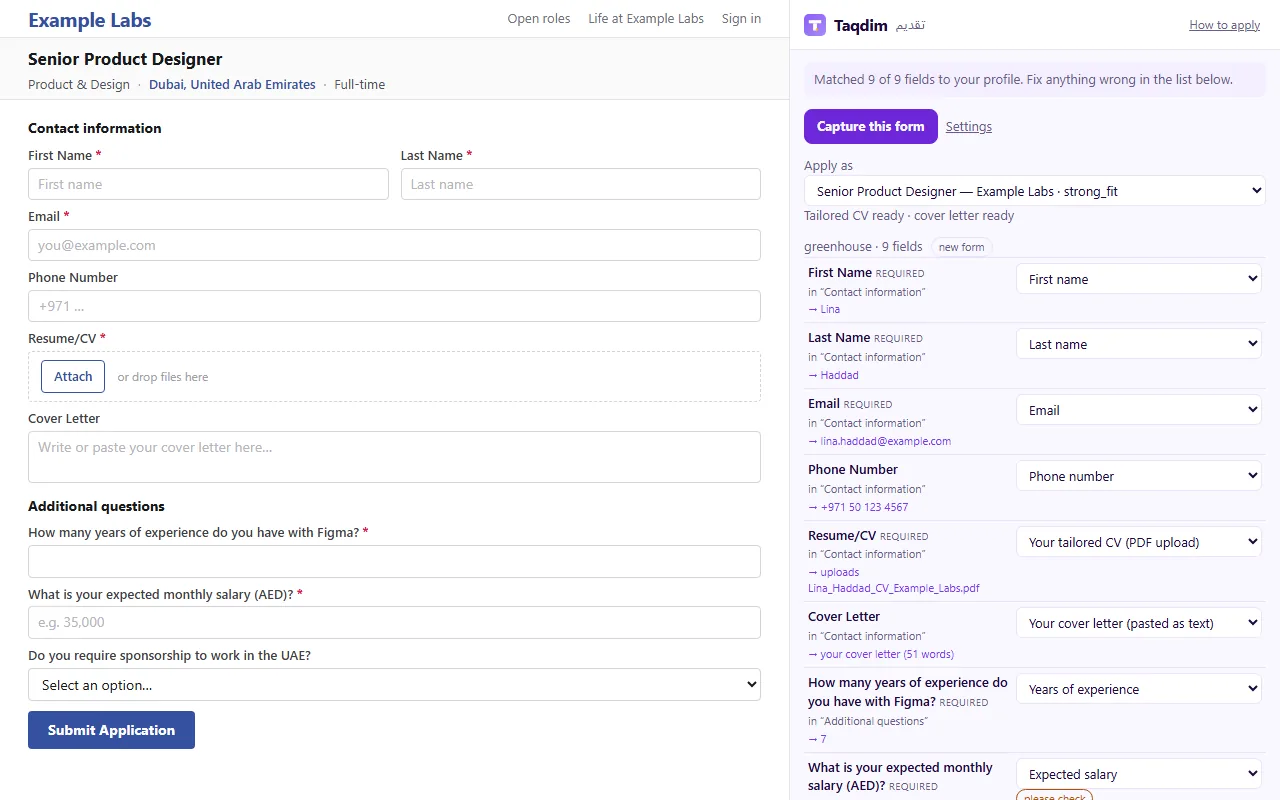
What hasn't changed: the extension fills the form on the page you're viewing, and you review every field and click Submit yourself. It never submits a form, never clicks Apply, never solves a CAPTCHA and never fills self-identification questions such as gender, ethnicity or disability.
Help and the website
- How to apply with Taqdim walks through the whole flow in eight steps, from your profile to the moment you click Submit.
- A video walkthrough sits on that page, in English and, on the Arabic page, in Arabic. Nothing loads from YouTube until you press play.
- A new look for the site and the app, with a new logo and colours. Both follow your device's light or dark setting until you pick one.
- Errors you can read. When a paid step fails, the message stays on screen until you close it, and error pages now carry the Taqdim header in English or Arabic.
- Clearer sign-up. The sign-in and sign-up screens now say first that the beta is invite-only, and link to the waitlist.
Questions
Is Taqdim open to everyone? Not yet. It is in invite-only beta. You can join the waitlist below.
Does Taqdim apply for me? No. The extension fills the form, and you review every field and click Submit yourself.
Do I need to update the extension? Chrome updates extensions from the Chrome Web Store on its own schedule. You can see your version on Chrome's extensions page.
Where Taqdim fits
Taqdim checks whether a job is worth applying to, prepares a CV and cover letter for that job from your profile, and its Chrome extension fills the employer's form while you review every field and click Submit. Fit results are guidance, not a promise, and AI can make mistakes, so check everything before you send it.
Taqdim is in closed beta. Join the waitlist.
Related: How Taqdim's fit check flags knockout requirements · Tailored CVs and cover letters in Taqdim · Should I apply for this job? The honest job-fit checklist · Tailor your CV to each job, honestly.